Getting away from city lights to sleep under a glimmering night sky can be a transformative experience—few settings offer such a moving reminder of Earth’s infinitesimal place in our universe. Since 1988, the Tucson, Arizona–based DarkSky International has worked to certify and protect night skies around the world from light pollution by implementing controls and regulations that preserve the natural nighttime environment. There are now more than 250 such “Dark Sky Places” across 22 countries, with five categories ranging from remote Dark Sky Sanctuaries to Reserves and Communities, all committed to protecting nature at night and our view of the cosmos.
Accommodations in ultra-dark sky places have come a long way. Sure, you can camp, but you no longer need to rough it to sleep beneath a blanket of stars. Boutique hotels and lodges now dot these these Dark Sky preserves, offering plenty of creature comforts alongside front-row seats to the celestial show. Imagine waking up to the Northern Lights in a glass dome in the Arctic. Or falling asleep with the Milky Way shining above your open-air safari bed. How about stargazing at a Himalayan monastery? For Afar’s latest installment of Hotels We Love, we present the 19 best places in the world to sleep to behold nighttime wonders.
Adero Scottsdale Resort, Autograph Collection

Adero Scottsdale Resort, Autograph Collection, offers travelers spectacular dark sky views.
Courtesy of Adero Scottsdale Resort, Autograph Collection
Why we love it: Contemporary resort in a Dark Sky Community with guided stargazing evenings
Loyalty program: Marriott Bonvoy
Rates: From $184
Sitting 2,500 feet above the Sonoran Desert in the McDowell Mountains, Adero Scottsdale is a contemporary resort located in Fountain Hills, one of 64 International Dark Sky Communities (IDSCs) around the world. IDSCs are certified towns and communities that have implemented lighting ordinances and protections for the nocturnal environment.
The town is home to the International Dark Sky Discovery Center, which is under renovation and reopening fall 2026 with an astronomical observatory and planetarium. Adero, an independent hotel under Marriott’s luxury and lifestyle Autograph Collection, has a designated area for stargazing, and most Friday evenings a local astronomy group guides guests through the night sky using telescopes, binoculars, and naked-eye stargazing.
The resort offers guests a premium version of Star Walk 2, an augmented reality app that allows users to explore the constellations and planets by pointing their phones at the sky. The resort takes full advantage of the town’s abundant dark skies. The 177 rooms and suites have either mountain or desert views and feature balconies for private stargazing sessions; book a corner Dark Sky Suite for floor-to-ceiling, south-facing windows perfect for stargazing.
The star-themed restaurant, Cielo (“sky” in Spanish), serves modern American dishes such as braised beef short ribs with roasted heirloom carrots and grits on an outdoor deck under the stars.
Anantara Kihavah Maldives Villas

Anantara Kihavah Maldives Villas is in the wildlife-filled waters of the Baa Atoll archipelago, a UNESCO Biosphere Reserve.
Courtesy of Anantara Kihavah Maldives
Why we love it: Tropical villas with an overwater astronomical observatory
Rates: From $1,805
Surrounded by hundreds of species of tropical fish, hawksbill turtles, reef sharks, and eagle rays, Anantara Kihavah Maldives Villas is in the Baa Atoll archipelago, a UNESCO Biosphere Reserve. Guests have unfettered access to dark and starry night skies, not only because the resort is set remotely in the Maldives, but also because it’s near the equator, thus offering views of constellations from both hemispheres.
At the resort’s astronomical observatory—the first overwater observatory in the Maldives—the resident astronomer guides guests with a powerful 16-inch Meade telescope and relays Maldavian stories of the stars. It sits next to the Sky bar, which serves zodiac-themed cocktails: The Aries is a zesty blend of gin, melon, yuzu, and sugar while the Gemini combines Campari, tequila, Dubonnet, and cassis.
Each of the 80 villas has a private infinity pool, sunken glass-bottom bathtubs, natural wood floors, and airy open decks. There are seven on-site restaurants and bars, including the underwater Sea restaurant and the Japanese-Peruvian Fire.
The resort was constructed in a way that preserves the delicate biosphere, with structures designed around the landscape so that no trees would need to be cut down. Guests can also participate in the Coral Adoption Programme by planting coral in a reef nursery. The property has a zero-single-use plastic policy and a plant that turns sea water into potable water; it also gets a portion of its energy from solar power.
Americana Motor Hotel

Americana Motor Hotel is on Route 66.
Courtesy of Americana Motor Hotel
Why we love it: A charming midcentury motel on Route 66 set within a Dark Sky zone
Rates: From $160
In Flagstaff, the first-ever International Dark Sky Community (certified in 2001), Americana Motor Hotel is a restored motel along Route 66. The hotel reopened in 2023 after a complete refurbishment that has brought the 1960s motor lodge into the 21st century, with a modern design that draws heavily on retro aesthetics.
The 89 guest rooms pair midcentury-inspired furnishings (think rainbow plush headboards, bright geometric carpeting, and wood paneling) with contemporary bedding and wall decor that evokes retro-future and outer-space themes. The central courtyard has been reimagined as a gathering place with fire pits, corn hole and bocce ball courts, and a heated outdoor pool.
The hotel has taken its Dark Sky location seriously by employing shielded lighting and limited bright signage and even using nonreflective paint to curb its light pollution. When guests book, there’s an option to add tickets to Flagstaff’s historic Lowell Observatory, where Pluto was discovered, and a “Meet a Scientist” event.
andBeyond Sossusvlei Desert Lodge

The andBeyond Sossusvlei Desert Lodge
Courtesy of andBeyond Sossusvlei Desert Lodge
Why we love it: Sustainable, sleek design with starry nights under the Namibian desert sky
Rates: From $1,335
Since its founding in 1991, andBeyond has developed a proven model of impact and conservation with care of the land, wildlife, and people at its core. andBeyond Sossusvlei Desert Lodge sits on a vast private concession in the Namib Sand Sea, a coastal fog desert and UNESCO World Heritage site that’s home to the largest sub-Saharan dune field. The lodge borders the NamibRand Nature Reserve, the only Dark Sky reserve on the African continent designated by DarkSky International. With the nearest town close to 90 miles away, the sky here measures as one of the darkest on Earth.
The lodge’s 11 glass suites sit along the curve of an escarpment, each producing solar energy to power the air-conditioning, water treatment, and recycling systems. Floor-to-ceiling glass panels offer views of the desert and the night sky, and there are stargazing skylights above each bed and in the spa treatment room.
In the evening in a dedicated observatory area with cushioned seating, astronomers-in-residence offer a tour of the night sky using an 11-inch Celestron computerized telescope, which can zoom in on such deep sky objects as Saturn’s rings and colorful nebulae, the gaseous regions where stars are formed.
At sunset, animals congregate at a nearby water hole, which makes for outstanding twilight wildlife viewing. Daytime adventures include hikes of the aptly named Star Dunes, hot air ballooning, and desert drives that teach visitors about the ecosystem, geology, and Indigenous peoples. Guests can enjoy desert sundowners to watch night fall with a drink in hand.
Astrostays

Astrostays in Ladakh, India, is near Pangong Lake.
Courtesy of Astrostays
Why we love it: Stargazing with monks in peaceful Himalayan villages
Rates: From $62
A community-led program of homestays in Ladakh, India, Astrostays aims to create regenerative livelihoods for remote Himalayan communities. The program is part of Global Himalayan Expedition, a regenerative travel social enterprise that uses tourism revenue to electrify remote villages and create educational opportunities. It trains local homestay owners, many of whom are women, how to operate a community telescope located in a public area at the village center, and those owners then lead guests on stargazing adventures under the high, arid Ladakh night sky.
Astronomy is at the heart of these homestays. But they also offer visitors ample opportunities to connect with local cultures. A community space, Cosmohub, started by a group of women from the village of Phyang near Leh, is adjacent to a 16th-century Buddhist monastery. A visit integrates stargazing with a monastic prayer session and traditional Ladakhi dinners like momos (dumplings) and thukpa (noodle soup), cooked with produce from a local greenhouse, plus a guided tour of its astronomy exhibit.
Basecamp Samburu

Basecamp Samburu sits in the heart an 8,000-square-mile expanse of arid bushland along the Great Rift Valley in Kenya.
Photo by Brian Siambi
Why we love it: Game drives and walking safaris by day, “star safaris” by night
Rates: From $1,025 (two night minimum)
Kalama Community Wildlife Conservancy in central Kenya is a 62-square-mile community-run wildlife conservancy patrolled by Morani–Samburu warriors who live in the bush. The conservancy works to protect both its dark skies and its threatened species through community-led conservation initiatives that create livelihoods for locals.
Those efforts include tourism, such as safari camp Basecamp Samburu in the heart of Samburu County, an 8,000-square-mile expanse of arid bushland along the Great Rift Valley. It’s operated by Saruni Basecamp, a collection of 13 camps and lodges in Kenya owned by a Norwegian conservationist.
The canvas-walled tented camp was built with local materials, with only five tents plus a common area; it’s intimate, quiet, and deeply immersed in nature. The big draw for budding astronomers is Basecamp Samburu’s star bed, a plush double bed on a wooden platform, surrounded by mosquito netting, for viewing the night sky.
Related: Afar’s full experience of dark sky viewing at Basecamp Samburu
Battlesteads

Star trails above Battlesteads in Northumberland, England
Courtesy of Battlesteads Hotel & Observatory
Why we love it: Upscale English inn meets astronomical observatory in a Dark Sky Park
Rates: From $168
A marriage of posh English country hotel and astronomical observatory, Battlesteads hotel and its observatory makes for an alluring Dark Sky getaway. On the edge of Northumberland International Dark Sky Park—established in 2013 as England’s largest Dark Sky preserve—Battlesteads Observatory offers talks, stargazing, and astronomy courses by a team of professional astronomers.
On the same property, the 22-room Battlesteads hotel is housed in an 18th-century stone farmhouse; adjacent to it are five stand-alone rooms built from sustainably sourced local wood. Lodgings are located down a quiet pathway near the observatory.
Stargazing and other nighttime activities like aurora hunting are on offer almost every evening. Sustainability is baked into Battlesteads’ operations, which include a carbon-neutral heating and hot water system from a biomass boiler. Its gardens supply produce for the restaurant, which serves such dishes as seasonal game, house-cured trout , and summer salads.
Dark Sky Dome

Dark Sky Dome in Tallaminnock, Scotland
Courtesy of Dark Sky Dome
Why we love it: Stargaze from sleeping nets deep in a Scottish forest.
Rates: From $295
Located an hour’s drive southeast of Glasgow in Britain’s first International Dark Sky Park, certified in 2009, the Dark Sky Dome offers guests unfettered access to Galloway Forest Park’s starry nights. Opened by local amateur astronomer Christopher McCrindle, who comes from five generations of fishermen and was a navigator in the Merchant Navy, the open-plan dome is the largest of its kind in Scotland and offers a glamping-style stay.
Up to four guests (ages 12-plus) can sleep in a king bed and a pull-out futon, while an upstairs area contains two mezzanine nets on which to recline and stargaze through the dome’s clear plastic roof. Although accommodations are rustic, there are plenty of creature comforts, including Wi-Fi, a wood stove, an indoor shower and toilet, and a full kitchen. (Guests must bring their own food but there is a village shop five miles away.)
The dome has no exterior lighting (guests are given flashlights) and its interior “Block Blue” light bulbs don’t emit damaging, short-wavelength blue light, allowing eyes to stay adjusted to the surrounding natural darkness. Guests frequently spot local nocturnal wildlife, including owls, badgers, and pine marten.
Explora Atacama Lodge

Explora Atacama Lodge in Chile has one of the country’s best private observatories.
Courtesy of Explora Atacama
Why we love it: Nature-focused lodge with a private observatory
Rates: From $770 all-inclusive (minimum two nights)
Thanks to a dry, high-altitude climate, the skies above Chile’s Atacama Desert are some of the world’s clearest and darkest, and Explora Atacama Lodge, in the settlement of San Pedro de Atacama, takes full advantage of them. The Milky Way, which Atacama Quechua speakers call Mayu, or “celestial river,” is a nightly spectacle above the lodge.
Explora Atacama has a private observatory with a Meade 16-inch f/10 LX200R RD telescope, which means it can show brighter star clusters and detailed surface features on the planets in our solar system. Staff astronomers lead nightly open-air stargazing sessions that cover basic astronomy, the solar system, and deep space.
The lodge is only 30 miles from the ALMA international radio observatory, which offers guided tours that reveal how the telescopes listen to radio waves emitted by gas and dust in deep space, offering insights into the origins of the universe. The 50 adobe-style guest rooms and suites sit on 42 acres of land with ruins of an ancient Aymara Indigenous settlement whose historic buildings and pathways have been preserved. The open-air spa features four natural pools, a sauna, and steam baths, all surrounded by the original landscape and native plants, such as pampas grass and high desert flowers.
Hoshinoya Taketomi Island

Hoshinoya Taketomi Island
Photo by Hirofumi Inaba
Why we love it: Low-rise luxury resort on a tropical island Dark Sky Park
Rates: From $258
Remote Taketomi Island, which sits in the southernmost reaches of Okinawa, is part of Iriomote–Ishigaki National Park—Japan’s first Dark Sky preserve, established in 2018. To protect the natural environment of the island, Hoshinoya Taketomi Island worked with Masanobu Takeishi from Tokyo-based lighting design firm Illumination of City Environment to create a lighting scheme that uses sparse, small lights in key locations that give way to moonlight and starlight.
There are no tall structures on Taketomi, so guests can view the night sky from any vantage point. All of Hoshinoya Taketomi Island’s 48 villas are single-story wooden buildings that follow the island’s traditional architecture: stone walls, white-sand gardens, and red-tile roofs. In the bar, you can sample traditional Okinawan rice-wine cocktails, and the swimming pool is designed to reflect the sky, at night turning into a stargazing float pool.
During summer months, the resort offers a dining experience under the stars. The five-course dinner pairs contemporary French techniques with such local Okinawan ingredients as octopus terrine, tiger prawns, and mangoes. Aperitifs are served in the dining room before dinner, when guests move to an outdoor table with a view of the village. Diners enjoy the blue hour and take in the cosmos as the sky gradually darkens and the stars appear.
Longitude 131

A Dune Pavilion Bedroom at Longitude 131.
Courtesy of Longitude 131
Why we love it: Understated Outback elegance with Indigenous-led stargazing overlooking Uluru
Rates: From US$3,161
Australian Indigenous groups are among the world’s first astronomers, with thousands of years of star knowledge and an early understanding of the night sky. With almost no urban development, Uluṟu-Kata Tjuṯa National Park contains some of the most expansive skies in the world, offering unobstructed views from horizon to horizon.
Sitting adjacent to the park is Longitude 131, a luxury tented camp that overlooks the Outback’s vast, dusty Red Centre and the famed monolithic Uluṟu (Ayers Rock) and the Kata Tjuṯa domed rock formations. The lodge’s 16 tented pavilion suites are designed to have minimal impact on the delicate, red-dune environment.
Tents have floor-to-ceiling windows with views of Uluṟu, and private outdoor decks have eco-friendly, clean-burning fireplaces and safari beds for sleeping under the stars. For knockout views of both Uluṟu and Kata Tjuṯa, book the two-bedroom Dune Pavilion suite, with private outdoor stargazing beds and an outdoor plunge pool to soak up the sky.
Guided excursions include sunrise and sunset walks around Uluṟu and Kantju Gorge and sundowners at a sunset viewing area with a pop-up bar to watch the light change into night over the desert. Uluṟu Astro Tours, which can be booked by the resort, offer visitors a deeper understanding of ancient Indigenous astronomy and starlore, such as the story of the Great Emu, made up of dark patches in the center of the Milky Way.
Métis Crossing Sky Watching Domes

You won’t need to leave your snug and warm dome at Métis Crossing, where you can simply look up and see the northern lights.
Courtesy of Travel Alberta/Jenna Dixon
Why we love it: Views of the northern lights from clear-domed suites set deep in the Albertan wilderness
Rates: From $320
About 90 minutes by car northeast of Edmonton, Métis Crossing is a cultural destination dedicated to sharing the living traditions of the Métis, one of three distinct Indigenous groups in Canada. The Métis community emerged in the mid-18th-century during the fur trade through relationships between First Nations women and European traders, eventually developing their own language, traditions, and culture rooted in life on the land.
Today, the riverside property is a hub for cultural learning and outdoor exploration, with activities including wildlife tours to see rare white bison and guided paddling excursions along the North Saskatchewan River. Thanks to nearly zero light pollution, stargazing is also on offer. For generations, the stars and constellations helped guide Métis travelers across the plains, serving as a navigation system that informed when to hunt, plant, and move across the land. That knowledge shapes the experience of staying in Métis Crossing’s Sky Watching Domes, where guests can reconnect with the night sky much as Métis ancestors once did.
The domes themselves have transparent ceiling panels positioned above a king-size bed, so guests can spot constellations or maybe the northern lights without leaving their room. Heated floors (a must in the cold Canadian winter months), a kitchenette, and a private bathroom bring boutique-hotel comforts to the glamping-style domes. Single-suite domes accommodate two guests, while family domes with an additional pull-out couch and bunk beds accommodate between six to nine guests. To offer the most vivid prairie skies possible, all the domes are located a quick drive away from the main lodge.—Shayla Martin
Mt. Cook Lakeside Retreat
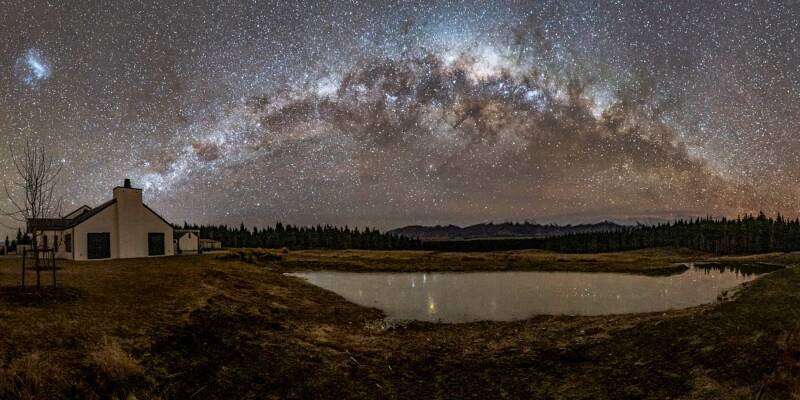
Mt. Cook Lakeside Retreat in New Zealand
Courtesy of Mt. Cook Lakeside Retreat
Why we love it: Tuscany-inspired villas with an astronomical observatory that doubles as a wine cellar
Rates: From US$2,238 (two night minimum)
Located in the vast Aoraki Mackenzie International Dark Sky Reserve (the first in the Southern Hemisphere, certified in 2012), Mt. Cook Lakeside Retreat is so remote it practically has no light pollution. Each of the four villas is a private, two-bedroom lake house decorated in Tuscan farmhouse style with big windows. All face the turquoise waters of Lake Pūkaki and the Ben Ohau Mountain Range and have outdoor hot tubs for relaxing under the night sky.
A culinary team provides fresh fare, such as local freshwater king salmon and fjordland venison, either in your villa or the communal Moraine Lodge dining area. Guests can also book a “Billion Star Dining” experience, a multi-course dinner in the lodge followed by a stargazing experience.
The retreat’s nocturnal calling card is its purpose-built wine cellar and astronomical observatory. Here, guests can take part in a wine or whiskey tasting followed by a guided tour of the night sky through a nine-inch reflector telescope in an observatory with a retractable roof. Stargazing experiences include twilight viewing and late-night telescope observing.
As its name suggests, Mt. Cook Lakeside Retreat is about 30 miles from New Zealand’s highest peak, Aoraki /Mount Cook, which makes for an easy day excursion. Surrounding the property are three miles of walking trails and wellness activities, including forest bathing, yoga, and in-room massage treatments.
Northern Lights Ranch

Northern Lights Ranch is above the Arctic Circle in Finnish Lapland.
Courtesy of Northern Lights Ranch
Why we love it: Scandi-chic cabins for stargazing and aurora borealis–hunting
Rates: From $490
Above the Arctic Circle in Finnish Lapland, Northern Lights Ranch was designed to offer convenient access to the night sky and the aurora borealis via Kittilä International Airport 18 miles away. Located just north of the ski resort village of Levi, the ranch sits within an area that’s far away from light pollution.
The 25 Sky View cabins were built with oversize windows and heated glass roofs designed for cozy stargazing and aurora viewing from bed. Book a Deluxe cabin, which can accommodate up to three adults or a family of four. It has a double bed, an additional alcove sofa bed, and a private outdoor hot tub for evening soaking as the aurora dances above. All cabins have beech walls, modern furnishings, and kitchenettes.
To get the best chance at seeing and photographing the northern lights, book an aurora-chasing tour, available year-round but best in winter. The tour equips travelers with Arctic overalls, winter boots, and a headlamp and offers brownies and hot berry juice along the way.
São Lourenço do Barrocal

São Lourenço do Barrocal is within Portugal’s Alqueva Dark Sky Reserve.
Photo by Nelson Garrido
Why we love it: A 200-year-old family-owned farm stay set within Portugal’s Lake Alqueva Dark Sky Reserve
Rates: From $475
Set in Portugal’s Alentejo countryside near the medieval village of Monsaraz, São Lourenço do Barrocal is a 19th-century farming estate that has evolved into one of the country’s most atmospheric rural retreats. The property’s story mirrors Portugal’s own recent history: After the Carnation Revolution in 1974 forced the Uva family off their ancestral land, the estate sat largely abandoned until the family repurchased part of it in 1986.
Years later, eighth-generation owner José António Uva began reimagining the farm as a hospitality experience, spending time reacquainting himself with the land before commissioning Pritzker Prize–winning Portuguese architect Eduardo Souto de Moura to restore the granite farm buildings. The result, opened in 2016 after a 14-year project, is a hotel that feels intimately connected to its past—from terra-cotta floors fired in nearby Corval to olive groves and vineyards stretching beyond the whitewashed walls.
The estate sits within one of Europe’s most remarkable night-sky landscapes. Just beyond the property lies the Alqueva Dark Sky Reserve, a stargazing region surrounding Lake Alqueva, where on many nights, minimal light pollution reveals a canopy of clear stars. Guests can join a local astronomer in the estate’s former apiary, visit the nearby Alqueva Lake Observatory, check out the museum of astrophotography at the Dark Sky Alqueva Official Observatory in Cumeada, or simply step outside after dinner, when the Alentejo becomes one of the continent’s most compelling places to look up.—Jennifer Flowers
Sensei Lānaʻi, a Four Seasons Resort

At Lanai Observatory, learn how Native Hawaiians and other Indigenous people of the Pacific used the stars to guide their boats.
Courtesy of Four Seasons
Why we love it: An adults-only wellness retreat in Lānaʻi’s green interior set within a Dark Sky Community with guided stargazing evenings
Rates: From $1,355
Set in the green heart of the island amid tranquil meditation gardens and an enviable art collection, the adults-only Sensei Lanai, a Four Seasons Resort, weaves together personalized wellness programs with consultations, spa treatments, fitness classes, lectures, and island adventures—not to mention daily dining from Nobu. The 96 guest rooms have views of towering pine trees or sculpture-filled gardens.
Spa treatments happen in private hales (with indoor and outdoor showers, infrared saunas, Japanese ofuro bathtubs, and private plunge pools). Lounge by the pool or enjoy island activities, sometimes shared with guests from sister property Four Seasons Lānaʻi. At Sensei by Nobu, sample dishes that incorporate the property’s nutritional philosophy as well as Nobu classics (miso marinated black cod, anyone?).
Through the cultural ambassadors of the resorts’ Love Lanai program, guests of Sensei Lanai (and its 213-room coastal sister property, Four Seasons Resort Lanai) can enjoy one-hour guided visits to the Lanai Observatory, which has a telescope 25 feet in diameter. Learn about how Indigenous Hawaiians and other Pacific Islanders used the stars to guide their way.
Related: See Afar’s full list of the 23 top resorts in Hawai‘i.
Skyview Hotel

A guest room at the Skyview Hotel
Courtesy of Skyview Hotel
Why we love it: A chic desert boutique hotel in a Dark Sky Community
Rates: From $229
The boutique, art-forward Skyview Hotel is in the International Dark Sky Community of Torrey, Utah. The hotel was designed by couple and co-owners Joshua Rowley and Nicholas Derrick, who chose to build it in Torrey due to its Dark Sky status. Custom art installations, including one by Rowley consisting of suspended ropes, evoke the red-sand and canyon landscapes of nearby Capitol Reef National Park, an International Dark Sky Park. The hotel’s sustainability ethos can be seen in furnishings made from recycled and sustainable materials, water conservation efforts that include efficient laundry systems, in-room recycling, and xeriscaping (requiring little to no water) to embrace the local biosphere.
Dark-blue, tiled floor-to-ceiling headboards in the 14 guest rooms evoke the area’s starry nights. Accommodations also have private patios overlooking Torrey’s red-rock cliffs, some with private hot tubs perfect for gazing at the stars. There are also six boutique glamping domes, with skylights for stargazing from bed. Lighting throughout the property is designed to eliminate light pollution. From mid-May to mid-October, the National Park Service rangers run stargazing programs, or you can book with the reputable Capitol Reef Star Tours. The hotel offers binoculars and a stargazing audio experience for guests to try.
Under Canvas Lake Powell – Grand Staircase

Tented accommodations at Under Canvas Lake Powell – Grand Staircase
Photo by Travis Burke
Why we love it: Luxury desert safari at the world’s first Dark Sky–certified resort
Rates: From $251
In 2023, Under Canvas Lake Powell – Grand Staircase became the first resort certified by DarkSky International as part of its new DarkSky Lodging program. Under Canvas operates a collection of luxury glamping resorts, with its Lake Powell property in southern Utah sitting under dark and starry skies, and within striking distance of several International Dark Sky Parks, such as Zion and Grand Canyon National Parks.
To comply with DarkSky International’s certification requirements, the resort has a strict lighting management plan to ensure all lights are dark-sky friendly. Situated on a canyon rim with vast views over the moonlike landscapes of Grand Staircase-Escalante National Monument and Lake Powell, Under Canvas features 50 safari-style canvas tents on elevated decks with en suite bathrooms that have showers and flushing toilets.
Book a Stargazer Tent, which has a viewing window above the king-size bed so you can gaze at the heavens from your pillow. A large reception-lodge tent features a relaxed dining area and bar with a deck overlooking the canyon. Stargazing evenings with a small telescope, sometimes including meditation, are a regular offering.
Wild Wetlands Lodge

Wild Wetlands Lodge in Iberá National Park, Argentina
Photo by Megan Eaves
Why we love it: Remote lodge in a national park surrounded by marshland wildlife
Rates: From $460
In the center of Iberá National Park, a vast wetland area in Corrientes province in northern Argentina, Wild Wetlands Lodge is an off-grid dream surrounded by nature during the day and the heavens at night. Run by passionate conservationists and wildlife experts, wife-and-husband team Alejandra Boloqui and Cepi Oporto, the lodge is the only accommodation in the Iberá marshlands, which is filled with birdlife, caiman alligators, marsh deer, and a herd of resident capybara.
Two main cabins have accommodations with huge decks overlooking the marshes, while a small selection of budget rooms and cabins are also available. The property has an organic garden that supplies fresh produce for meals, and the on-site wood grill is often fired up for an Argentinean asado.
At night, Wild Wetlands Lodge enjoys starry skies from horizon to horizon, with no light pollution anywhere in the reserve. Views include familiar constellations and celestial objects, along with those visible only in the Southern Hemisphere, including the Magellanic Clouds. Throughout the year, the lodge hosts star parties and stargazing events, including guided astronomy storytelling with an Indigenous Guaraní astronomer.
This article was originally published in 2023 and most recently updated on March 13, 2026, with current information. Jennifer Flowers and Shayla Martin contributed to the reporting of this story.